AI Overview: In 2v2, your partner’s deck matters as much as yours, because the team shares its elixir. RoyaleTracker’s October 2026 data shows heavy decks won 64.9% (two lists over 3,292 battles), while 3.0 to 3.4 elixir lists won 55.2% and 2.9-or-less lists won 56.5%. The tracker prints decks, not pairs, so no pair has a win rate.
Last Updated: October 2026
Key Points:
- RoyaleTracker prints 2v2 decks one at a time. It does not print partner pairs.
- Lists at 2.9 elixir or less won 56.5% on average over 18,029 battles (8 lists).
- Lists from 3.0 to 3.4 won 55.2% over 9,580 battles (8 lists).
- The two lists at 3.5 elixir or more won 68.0% and 58.6%, 64.9% on average over 3,292 battles.
- Averages are weighted by battles and mix single decks, so treat them as a guide, not a rule.
Table of Contents
How Shared Elixir Changes Deck Choice
In 2v2 the two players on a team share one elixir bar. A heavy push by one player costs the other. A cheap defense by one player gives the other room to attack. So the best partner is not the one with the best deck on paper, it is the one whose deck fits yours.
The short version: pair one deck that cycles fast with one that hits hard, or two decks that both defend well. The catch: the tracker does not publish pair data, so the pairings below are ideas built from the single-deck numbers.
What changed: SeeMeta lists cuts to several of the cheap-cycle cards in these lists. Ice Golem lost hitpoints on September 8, Ice Spirit and Fire Spirit lost hitpoints on August 4, and Evo Cannon‘s barrage fell on October 6. Goblinstein was reworked on August 4. What it means: the cycle decks are a little weaker than in summer, and the numbers below include the first weeks of that change.
Cycle decks lost small amounts of hitpoints and damage in the same weeks, and their win rate is still 56.5%. If another round of small cuts lands, the gap to heavy decks may widen. The negative effect: a format with many cheap decks makes a single heavy partner a bigger target.
Win Rates by Elixir Band
Split the 18 printed lists by average elixir. Eight lists run 2.9 or less: 56.5% on average over 18,029 battles. Eight run 3.0 to 3.4: 55.2% over 9,580. Two run 3.5 or more, the Bridge Spam list (68.0%) and a Golem list with Evo Elite Barbarians and Evo Electro Dragon (58.6%): 64.9% over 3,292.
| Build | Cards | Avg elixir | Win rate (sample) |
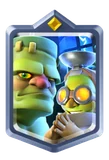
| Cheap cycle: Rune Giant with Evo Bats and Evo Cannon | 2.9 | 67.2% (4,019 battles) | |
| Cheap cycle: Hog with Hero Musketeer and Hero Ice Golem | 2.6 | 53.9% (1,531 battles) | |
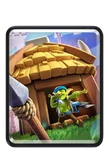
| Mid: Goblinstein with Goblin Hut | 3.4 | 65.6% (1,383 battles) | |
| Mid: Graveyard Tornado | 3.4 | 61.5% (1,094 battles) | |
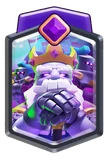
| Heavy: Bridge Spam | 3.8 | 68.0% (2,206 battles) | |
| Heavy: Golem with Evo Elite Barbarians | 4.5 | 58.6% (1,086 battles) |













The pattern: the cheapest lists are the most played, the heaviest lists win the most, and the middle band has both the best (62.8%) and the worst (43.5%) lists. What it means: elixir cost alone does not decide it. Still unknown: the heavy band is only two lists, so it is a small sample.
Try it yourself: open the Clash Royale Deck Builder with the Golem, Evo Elite Barbarians and Evo Electro Dragon heavy build in the table above already loaded. It averages 4.0 elixir. This exact list is not in the tracker sample, so it has no win rate; it is the 58.6% list with Elixir Collector swapped for Zap.
How to Pick a Partner Deck
- Pair a fast cycle with a heavy hitter. One covers the bar while the other builds a push.
- Avoid two siege decks. X-Bow at 43.5% was the weakest list.
- Share the defense. If your deck has no building, hope your partner has one.
- Bring a cheap spell. Zap or The Log saves the team.
- Match plans. Talk about who pushes first.
Because pair data is missing, nobody can say which duo is best. If RoyaleTracker adds pair statistics, the numbers on this page will change. The negative effect: advice based on single decks can be wrong for a specific pair.
How to Counter Strong 2v2 Teams
- Two cheap cycle decks: expect fast attacks; keep a small spell ready.
- A heavy plus a cycle deck: the cycle deck defends while the heavy one builds. Hit the heavy deck early.
- Bridge Spam: a swarm and a building stop the ram.
- Both players on one lane: hit the other lane.
The catch: with two opponents, you have to read both of their elixir bars as one.
Is Pairing Worth the Effort?
Is it worth it? Yes. Elixir sharing means a poor fit can cost a match. The catch: there is no pair data, so test with a friend.
A 2v2 chart that shows only single decks hides which partners actually work. As more battles are tracked, pair data may appear. The negative effect: until then, guesses are all anyone has.
Go deeper: For the decks in the table, read our Rune Giant guide, our Bridge Spam guide and our Electro Dragon guide. For the cycle side, see our Ice Golem guide. The Clash Royale Deck Builder is the quickest way to build your own version, because it keeps a running average cost.
Frequently Asked Questions
What is the best 2v2 partner deck?
RoyaleTracker does not print pair data. The best single decks are Bridge Spam (68.0%) and a Rune Giant cycle (67.2%).
Do teammates share elixir in 2v2?
Yes. The team shares its elixir.
Should both players use cycle decks?
It can work, but the tracker shows heavy decks won 64.9% on average, so one heavy partner may help.
Which decks lose most in 2v2?
Slow siege decks. The X-Bow list won 43.5% in the tracker sample.
Does elixir cost decide who wins in 2v2?
Not alone. The middle band had both the best (62.8%) and the worst (43.5%) lists.
How were the elixir bands calculated?
The 18 printed lists were split by average elixir, and win rates were averaged weighted by battle count.
Original Guide, Kept in Full
The text below is the original guide, kept in full. Its stats and win rates are older than the 2026 data above.
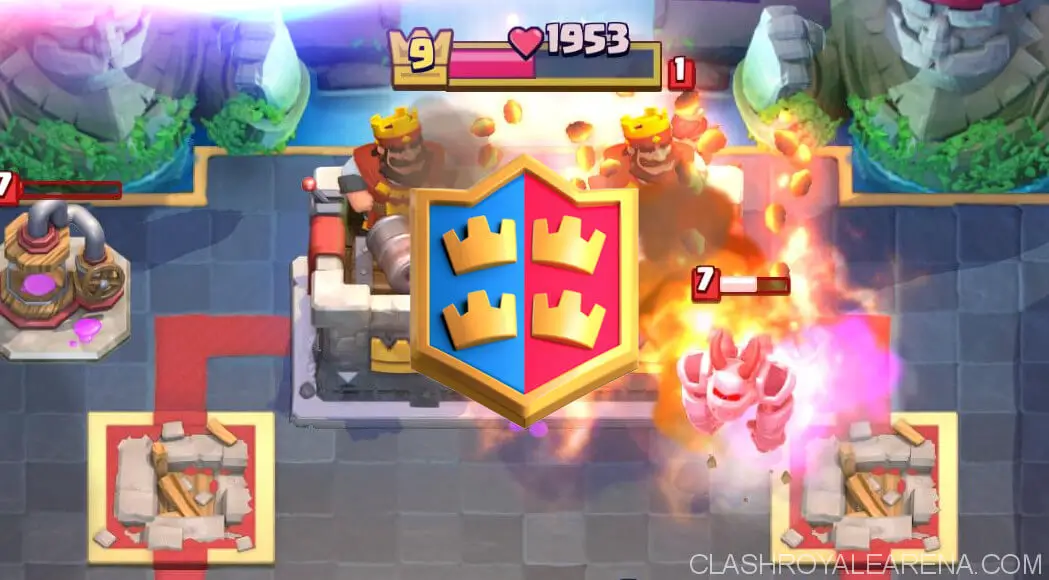
Hey clashers, this time I’m gonna talk about some of the best synergies among decks for 2v2.
I’ve splitted this guide into two parts to make it easier to read and write as well. So let’s get into it!
For more detailed tips on 2v2, take a look at this in-depth guide!
The Dual-Synergy:
Okay, before getting into the main subject, let me tell you about dual-synergy.
Just like two cards synergize with each other in a duel, two decks also synergize with each other during a 2v2 battle. Although you can possibly win tons of battles without actually caring about synergy (that’s what we do in a Quick Match), having two decks with synergistic combo between them greatly increases your chances of winning.
There are many deck combos that work better together. The list below covers some useful combos that I believe can help you in 2v2 matches ahead!
Note: This list is incomplete. Feel free to add more combos if you know, in the comment section below. I’ll update the post with your ideas!
Giant Beatdown + Graveyard Cycle
I guess all of us are aware of the infamous Tank+GY synergy.
This dual-synergy is based on the same principle. While there is a beatdown going on, a GY added in the mix, is devastating especially if it’s a GY poison cycle.
Beatdown decks normally lack the ‘cycling’ feature. That’s what the GY cycle is for! They can easily cycle to their defenses while the beatdown players can focus on their pushes.
Moreover, due to RNG feature of GY, just a simple Giant + GY combo is threatening if the opponent is not prepared. The cycling ability of the GY deck, allows to magnify even a small beat down push.
Here’s an example of this combo:
Deck #1
Deck #2
Gameplan:
Let’s assume Player #1 is using Giant Beatdown and Player #2 is using GY cycle.
During the start of the match, it’s better to cycle cards at the back and not go for a push. But if the opponent places a big tank at the back, feel free to Giant+GY them.
During the middle phase, push whenever you can after a successful defense by plopping a Giant in front of the alive troops and placing the Graveyard once the Giant crosses the river.
In 2v2 matches, Beatdown pushes can get easily defended, especially if it’s Giant Beatdown.
So the mindset while playing this dual-combo will be to cause as much damage as possible through GY+Spell combo and not letting them counterpush. Player #1 should save their defensive troops since Player #2 doesn’t have decent defense.
The Push: Giant+Splash Troop+GY+Spells should be a decent push in my opinion.
Bridge Spam+Spell-Bait
The bridge spam deck is really useful to bait opponent’s Log or Zap since it has battle ram. 9/10 times your opponent will use his Log on Battle Ram if he has it in hand. That’s where the spell bait deck shines.
Moreover, the ultimate defense of spell bait decks is useful to counter the opponent’s counterpush after a bridge spam push. The key is to not use ‘Log-able’ or Zappable troops together such as Battle Ram + GobGang.
Use Goblin Barrel as your win condition. If the opponent uses Skarmy/Minions/Gobgang to counter Goblin Barrel, then Poison comes handy, providing an awesome elixir advantage and an area denial for both your Battle Ram and the Goblin Barrel.
Recommended Decks:
Deck #1
Deck #2
Gameplan:
While playing with this combo, Player #1 must apply enough pressure to force their Log.
As starting hand, GobGang at the bridge or Princess or Knight at the back is preferred for Player #2.
Always remember to place the Princess in the opposite lane to force out their cards. Once the opponent uses his spell, feel free to toss Goblin Barrel. Poison if needed. Player #1 should play as usual. Read more about Vietnam’s Bridge Spam here.
The Push: Basically, Goblin Barrel and the spells does all the damage. Battle Ram+Goblin Barrel+Poison +Bandit is a decent push.
Hog Cycle + Hog Cycle
This one’s my favorite!
The reason why two Hog Cycle decks work amazingly is the same reason why Hog Cycle decks are popular; the ability to out cycle their counters and apply constant pressure.
Since both of the decks have cards that are meant to support the Hog push, the two players can do constant Hog pushes and can counter their counters easily. The players can also Dual lane pressure the opponent to baffle them up.
Read more about Hog Cycle here!
Example Decks:
Deck #1
Deck #2
Gameplan: I don’t think this needs much explanation. Just play normally as you would being a Hog Rider player.
The key to not letting them counterpush and apply uniform pressure in both lanes if possible. Use your spells to let the Hogs pierce through.
NEVER play two Hogs at once, push with each Hog periodically so as to bait their counters to Hog.
The Push: The small Hog pushes are your damage dealer. There’s no specific push to be honest. Spells can be also used to take down their tower during Sudden Death when everything’s is rapid.
However, counterpushing with remaining defense troops (like the Musketeer and Executioner) is your best push possible.
3M + Spammer
This one is interesting! And effective too!
I actually tried this combo with my friend and it worked wonderfully great! The reason why it works is because there are a lot of units that forces your opponent to use their medium/heavy spell, such as The Barbarian Hut, Goblin Hut, Elixir Collector, Furnace.
Once your opponent uses his Fireball, you know the next. 3M!
The spammer cards, being spell-bait, are also useful to apply dual lane pressure, which 3M decks aim to!
You can simply split your 3M with the lone Musketeer supported by the spawned Barbs and the other two by Battle Ram. And it becomes a pretty devastating push.
Example of this combo:
Deck #1
Deck #2
Gameplan:
As you might have figured out, both of the decks are heavy. So play defensively at first, pumping as much as possible.
Here are more possibilities decks:
1. Double Spawner Decks
Key Cards:
- Barbarian Hut
- Goblin Hut
- Furnace
- Royal Recruits
- Poison
- Log
- Electro Wizard
- Mega Minion
Strategy: Spawner decks can overwhelm opponents by continuously spawning troops that chip away at towers and distract enemies. In 2v2, the constant pressure from spawners forces opponents to split their attention and resources. Pairing this with defensive cards like Electro Wizard and Mega Minion ensures you can counter your opponents’ pushes effectively.
2. Golem + Support Deck
Key Cards:
- Golem
- Night Witch
- Baby Dragon
- Lumberjack
- Tornado
- Mega Minion
- Lightning
- Log
Strategy: The Golem deck is a classic for a reason. Its high health and destructive potential make it a formidable win condition. In 2v2, having a partner who can support the Golem with additional troops or spells can create unstoppable pushes. The Night Witch provides excellent support with her bat spawning ability, while the Lumberjack can add a rage boost to the mix. Use Tornado and Baby Dragon for effective defense and counter-push potential.
3. Hog Cycle + Control Deck
Key Cards:
- Hog Rider
- Ice Spirit
- Skeletons
- Cannon
- Musketeer
- Fireball
- Log
- Knight
Strategy: Hog Cycle decks focus on fast, relentless pressure. The Hog Rider is quick and can deal significant damage if left unchecked. Pair this with a control deck that focuses on solid defense and counter-attacks. The cycle aspect allows for frequent Hog Rider pushes, keeping the pressure on opponents while your partner supports with heavier defensive or offensive cards.
4. LavaLoon + Miner Poison Deck
Key Cards:
- Lava Hound
- Balloon
- Miner
- Poison
- Mega Minion
- Guards
- Arrows
- Inferno Dragon
Strategy: The LavaLoon combo is devastating when executed correctly. The Lava Hound serves as a tank while the Balloon deals massive damage to towers. In 2v2, coordinating with your partner to protect the Balloon and Lava Pups can lead to explosive damage. The Miner and Poison combo is excellent for taking out defending troops and chipping away at towers.
5. Royal Giant + Sparky Deck
Key Cards:
- Royal Giant
- Sparky
- Electro Wizard
- Minions
- Fireball
- Zap
- Furnace
- Guards
Strategy: Royal Giant’s range allows it to chip away at towers from a distance, making it a solid win condition. When paired with Sparky, you create a high-risk, high-reward scenario. Sparky’s splash damage can annihilate defending troops, paving the way for the Royal Giant. Support these heavy hitters with defensive cards and spells to protect them and maximize their potential.
Tips for 2v2 Success
- Communication is Key: Whether you’re playing with a friend or a random ally, communication can make or break your strategy. Use the in-game emotes and chat to coordinate attacks and defenses.
- Complementary Decks: Ensure that your decks complement each other. If one player uses a heavy deck, the other should consider a lighter, faster deck to balance out the elixir cost.
- Adapt to Your Opponents: Be ready to adjust your strategy based on what your opponents are playing. Flexibility is crucial in 2v2 battles.
- Elixir Management: With two players, elixir management becomes even more critical. Coordinate to ensure you’re not both low on elixir at crucial moments.
The Bowler and Executioner are great cards to generate Elixir Advantage.
If both opponents use their Fireball on something else other than 3M, split the 3M and slowly ramp up the push from the back.
You’re not gonna rush because of the ‘high risk, high reward’ property of this dual-synergy.
The Push: Two Muskies+Barb in one lane, 1 Musketeer + Other troops in the other lane. Keep your spells ready in case they counter with swarms.
Conclusion:
So here’s the end of the Part I of this guide! Hope it proved useful to you.
Provide your feedbacks, complaints and ideas in the comment section below! I’ll be posting the Part II very soon.
Till then stay tuned and clash on!
Sources
Researched from the following (no links, listed for transparency):
- RoyaleTracker, best 2v2 decks (682,034 battles analyzed, updated October 9, 2026)
- RoyaleTracker, best decks right now, normal battles (data from October 9, 2026)
- SeeMeta, Clash Royale balance changes 2026 (page updated October 8, 2026)
- Supercell, Clash Royale October balance changes 2026 (October 6, 2026)
- Clash Royale card data used by the Deck Builder (elixir costs and card types)
- Supercell official Clash Royale API, card list (elixir cost, rarity, Evolution and Hero flags)